
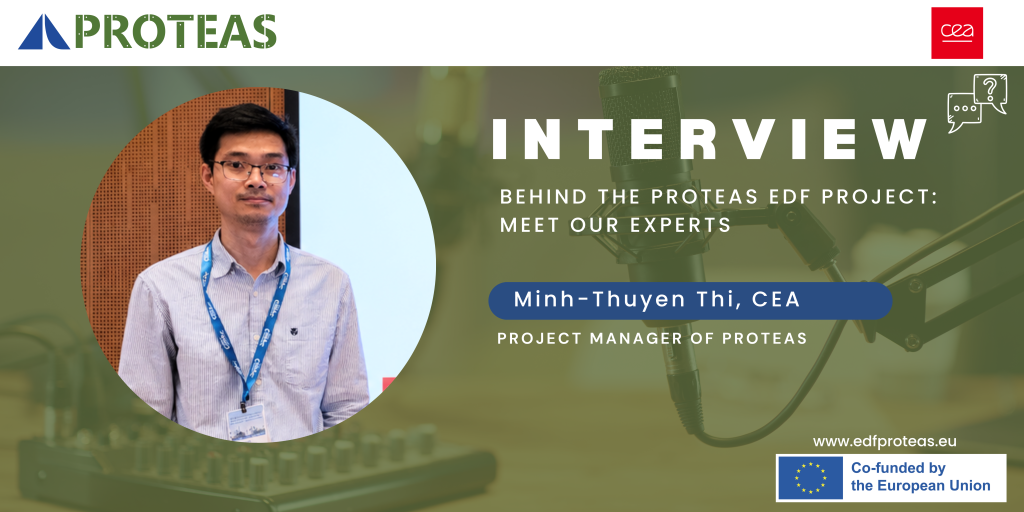

Interviewee: Minh-Thuyen Thi, Senior Researcher, CEA
Role in PROTEAS project: PROTEAS Technical and Project Manager
Question: Please describe in a few words the role of your entity in the PROTEAS project and the business goals you aim to achieve through the participation.
Minh-Thuyen Thi: CEA-List’s role in PROTEAS is to strengthen the cybersecurity and network management layer of the tactical ICT infrastructure that supports the future Special Operations Forces Command Post (SOFCP). A command post of this kind has to operate in the field, connecting a wide range of devices, sensors and communication links, which makes it a demanding test case for our research: cybersecurity and network management mechanisms have to keep working reliably even when the network traffic is heterogeneous. Our contribution centers on two complementary solutions that we adapted to operate alongside PROTEAS’s secure communication infrastructure: SIGMO-IDS, our Machine Learning-enabled Network Intrusion Detection System, and NMS, our intelligent network management component (which belongs to our complete NEON solution).
Building on this, our contribution is also to improve the Technology Readiness Level (TRL) of SIGMO-IDS and NMS, and to integrate them with the systems developed by our partners, notably through standardized data exchange. This integration permits cybersecurity events from different components to be consolidated into a shared operational view.
Through this participation, our business goals are twofold. Firstly, we develop new functionalities, adapt SIGMO-IDS and NMS for a SOFCP environment, and mature them into higher-TRL. Then we validate them with field-tested, realistic operational System-of-Systems. Secondly and more broadly, the project allows to position CEA-List’s cybersecurity and network management expertise as a reference building block for future secure tactical communication systems in Europe, while strengthening our ties with industrial and defense partners for collaboration beyond PROTEAS.
Question: Please describe in a few words the added-value presented by the envisaged PROTEAS outcomes and your view on their possible future adoption.
Minh-Thuyen Thi: The added value of PROTEAS lies in delivering a transportable, interoperable Special Operations Forces Command Post that brings together command and control, communications, sensing and cybersecurity into a single, coherent System-of-Systems. Rather than relying on isolated components procured separately, PROTEAS integrates the capabilities needed to both command and defend a modern tactical operation, from cyber-resilient communications to real-time situational awareness. From my perspective, one of the outcomes that will matter most is the demonstration that heterogeneous, independently developed systems can interoperate and have their security and operational information consolidated into a unified view. That is what allows a command post of this kind to stay both agile and defensible in the field.
I am confident about PROTEAS’s future adoption. It addresses a real capability gap and it was designed from the actual operational requirements of the Member States. This naturally positions PROTEAS as a solution these states can build on directly. Its modular architecture also means it can evolve incrementally: individual capabilities, such as the cybersecurity and network management functions we contribute, can mature, be upgraded or be reused independently as threats and mission needs change. This makes PROTEAS attractive to Member States and European forces looking for a ready, tested command-post solution, rather than one built from scratch.
Question: Please describe in a few words why the PROTEAS Consortium is the appropriate team for delivering such an innovative solution.
Minh-Thuyen Thi: PROTEAS brings together partners whose expertise covers precisely the layers that a System-of-Systems like this needs, such as platform and asset providers, C2/SOFCP experts, communications/cybersecurity specialists, each contributing components already proven in their own domain. What makes this consortium well suited to deliver a solid solution is not only this complementarity, but the willingness of the coordinator and partners to work toward interfacing and integrating from an early stage, so that independently developed systems can interoperate, rather than simply coexist.
Just as importantly, the coordinator and partners alike have been consistently committed to pushing beyond a laboratory demonstration, aiming to deploy real-life, high-TRL operational systems by the end of the project. That commitment shapes every technical choice we make, including on the CEA-List side with SIGMO-IDS and NMS. This is, in my view, the clearest sign that PROTEAS is the right team to turn an ambitious, multinational SoS concept into a solution that Special Operations Forces can actually use.