
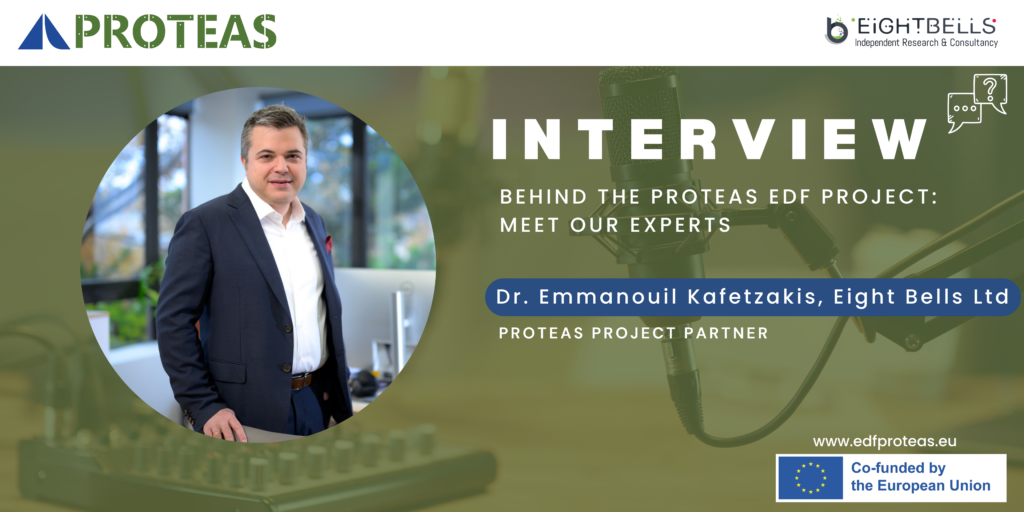

Interviewee: Dr. Emmanouil Kafetzakis, R&D&I Director, Co-Founder, Eight Bells Ltd
Role in PROTEAS project: PROTEAS Project Partner
Question: Please describe in a few words the role of your entity in the PROTEAS project and the business goals you aim to achieve through the participation.
Dr. Emmanouil Kafetzakis: Within the PROTEAS project, Eight Bells Ltd (8BELLS) plays a key role across both technical and strategic Work Packages. The company is actively contributing to the modification of an unmanned surface vehicle’s payload, to tailor it to SOF operations, to the Intelligence & Sensing Platform’s capabilities, as well as to provide the backbone for collecting sensor information from the various Perimeter Security System’s components. In this context, 8BELLS is responsible for the design and development of three dual-use technologies: (i) a Marine Multi-Sensor System, an advanced long-range EO/IR solution with laser range finding and two-axis stabilisation for integration on unmanned surface vessels; (ii) the METOC-INT subsystem, an AI-enabled Meteorological and Oceanographic Intelligence service offering a RESTful API for seamless data exchange and integration with ALLINT systems; and (iii) a secure, portable standalone 5G network enabling remote control, real-time data collection, and sensor management for enhanced situational awareness and physical security of the SOFCP area. In parallel, 8BELLS leads WP10, planning and executing the project’s dissemination and exploitation activities.
Through its participation, 8BELLS aims to increase the Technology Readiness Level of its core solutions, strengthen its dual-use product portfolio and position itself for market uptake and upscaling. Additionally, the company’s results will foster future collaborations within the defence R&I ecosystem.
Question: Please describe in a few words the added-value presented by the envisaged PROTEAS outcomes and your view on their possible future adoption.
Dr. Emmanouil Kafetzakis: In the context of increasing global instability and evolving operational challenges, solutions like PROTEAS are highly relevant for the future of European defence. The PROTEAS outcomes deliver clear added value by introducing a modular, rapidly deployable and resilient System-of-Systems tailored to Special Operations Forces (SOF). It combines secure communications, multi-domain C2, intelligence gathering and fusion, as well as integrated manned and unmanned assets into a unified and user-friendly operational environment. Despite its technological complexity, the system is designed to be flexible and easy to deploy, supporting a wide range of mission scenarios, with enhanced situational awareness. Importantly, PROTEAS strengthens European strategic autonomy by providing an interoperable and cyber-secure alternative to non-EU solutions, while remaining aligned with NATO standards.
In terms of future adoption, PROTEAS presents strong potential for deployment in real-world operations, particularly in environments requiring rapid deployment, high mobility, and accurate, real-time situational awareness. Beyond defence applications, its capabilities can extend to critical infrastructure protection and multi-agency security operations.
Question: Please describe in a few words why the PROTEAS Consortium is the appropriate team for delivering such an innovative solution.
Dr. Emmanouil Kafetzakis: The PROTEAS Consortium brings together a strong and well-structured team with the right mix of expertise to deliver a complex and innovative solution. It includes 14 partners and one affiliated entity from six EU Member States and Norway, combining industrial capabilities, technical knowledge, and operational experience across multiple domains.